
National Diet Library Web Archiving Project (WARP)

Our use of Cookies on NDL Web Archiving Project (WARP)

We used necessary cookies to make our website(https://warp.ndl.go.jp/)work as library services. We would also like to set analytics cookies that help us make improvements by measuring how you use our website. These cookies will be set only if you accept. You can revoke your consent with effect for the future at any time via the cookie settings.

Strictly Necessary Cookies : Always Enabled

  • Necessary cookies enable core functionality such as security, network management and accessibility.
  • You may disable these by changing your browser settings, but this may affect how the website functions.

Accept all Cookies : Usage Patterns Analytics Cookies

  • By using our website's statistical function, we collect website analytics information about usage patterns of website to evaluate and improve our services.

Cookies are small text files that are stored on your device (smartphone, tablet, laptop, etc.) when you visit our websites. For any question in relation to our policy on cookies, please see Privacy Policy .

About our use of cookies;

Mechanism of Web Archiving

We clearly explain the mechanism of web archiving. (The articles are written in Japanese.)

Mechanism of Web Archiving

  1. What is Web Archiving?
  2. Life Cycle of Web Archiving
  3. How to Harvest Websites
  4. Granularity of Managing Harvested Pages
  5. Harvesting Frequency
  6. Deduplication
  7. Organization of Archived Websites
  8. Long-term Preservation of Archived Websites
  9. Providing Access to Archived Websites
  10. Technical Challenges of Web Archiving

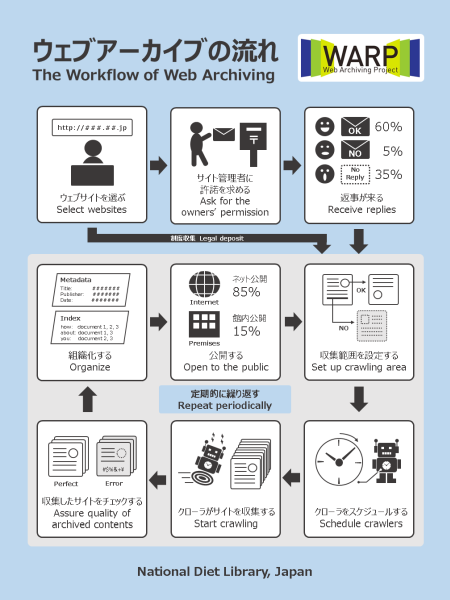
The Workflow of Web Archiving

The following figure simply shows the workflow of web archiving.